He Fucked the Girl Out of Me and the Autobiographical Potential of Video Games

The medium of video games has proven time and again that it can meaningfully contribute to a variety of genres – from sci-fi to familial dramas – alongside stalwart mediums like novels and films. However, autobiography has so far been mostly overlooked by video game developers. He Fucked the Girl Out of Me (HFTGOOM), the award-winning 2022 game by Taylor McCue, is an exception, and demonstrates that video games bring something unique to autobiography – something that simply cannot be achieved through other mediums.

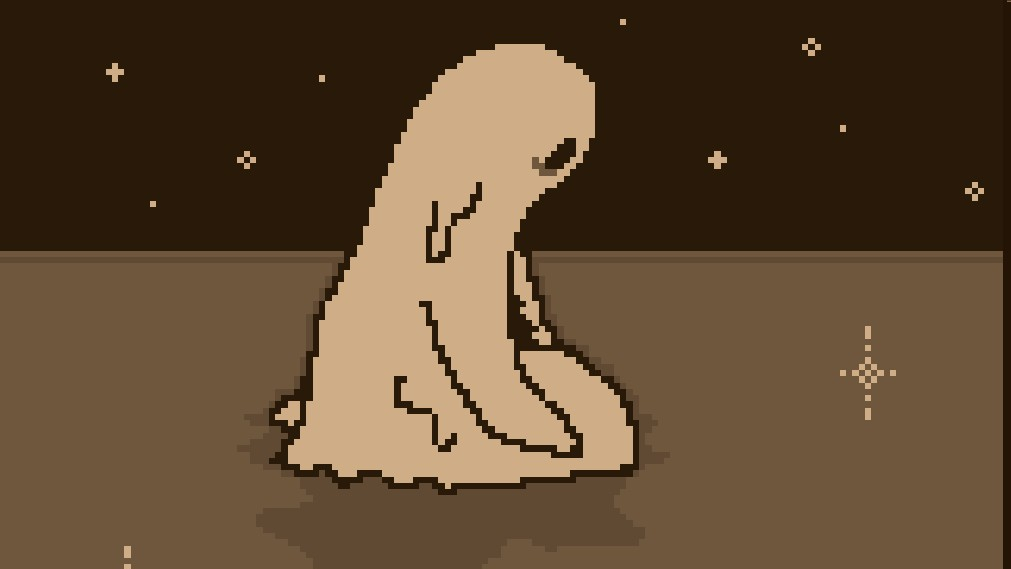
HFTGOOM is semi-autobiographical story about Ann, a trans person, who is coerced into sex work by a friend.1 The short, hour-long experience is more graphic novel than game: the author recounts their experience entering the sex trade, their first “date”, and their resultant trauma. It is undoubtedly a hard read, especially on account of the author’s stylistic frankness and honesty. And for the most part, it remains just that: a read. However, on the several occasions where the developer introduces interactivity, the experience deepens in a quite special way.

Take, for instance, the moment where the protagonist’s “date” places his hand on their upper thigh and “slowly start(s) inching up”. To you, the player, the developer asks: “Should I stop him?”. You are given two choices: “Resist” or “Stay still”. Both choices seem impossible. To stay still allows the assault to happen; to resist means offending your “date”, and who’s to say they will stop anyway? There’s no back button: to continue the narrative, you have to make a choice-that-isn’t-a-choice. For the player character and you, the player, there is no way out: every choice is the wrong one. You are trapped.

In a later scene, you move around a small room as a 2D sprite. There are two options available to you: walk around the room, or go upstairs to the bedroom to be with your “date”. When I played, I found myself doing everything I could to avoid going up the stairs – checking every corner, trying to find an exit. Finally, I realized there was no other option: I had to go upstairs. Again, the feeling of entrapment was palpable. Unable to do anything else, I made the ‘choice’ to go upstairs. And in so doing, I enacted the hesitation. I felt the claustrophobia. I experienced a shadow of the feeling of gross inevitability.

These feelings, I hazard, may reflect how the developer felt in the similar real-world scenarios.2 By playing as them, I embodied the experience in a unique way. What other medium allows empathy in such a way? When you read a novel, or watch a film, you feel sympathy for the characters, no doubt. But in video games, it’s different. You are the character. You have agency, you make decisions. You and the narrative are linked uniquely through interactivity.

HFTGOOM understands this dynamic, then manipulates it. You wish you didn’t have the agency granted to you by the game, because then you wouldn’t have to make a “choice”. Then you wouldn’t feel the confounding guilt that is always so mixed up with trauma: your actions brought you here, therefore it must be your fault. What other medium is so well suited to replicating, even in some small way, such complexity of feeling? Novelists, filmmakers and musicians can surely only dream of conferring such emotions through their art.

Given this unique ability of video games to emplace the audience within a setting, and to allow them active participation within that setting, it is surprising to me that more artists have not turned to the medium in order to tell autobiographical stories. To be sure, some developers are cottoning on to this and exploring the autobiographical potential of video games in really interesting ways. The recent Game Award nominee Despelote (2025), for instance, recreates the memory(s) of the developers’ upbringing through small sandbox levels you’re free to explore, and it does a fine job of providing that sense of carefree wonder, mischief and adventure that childhood memories seem to have. Consume Me (2025), a life-sim RPG based on the developers’ own teenage years, utilizes WarioWare-esque minigames to replicate the stress and lose-lose resource management of disordered eating.

Together with HFTGOOM, these works demonstrate how gamifying memories allows a deeper, more intimate approach to memoir. And given the burgeoning success of these games, we are likely seeing the blossoming of autobiography as a gaming sub-genre. My take is that it may well be the best way to tell autobiographical stories, period.

[1] The game is free to play on Steam, by the way, if you want to give it a try.
[2] Here, I am cautious not to make the claim that playing this game somehow mirrors the trauma of the actual experience; just that it provides a means to empathize with such situations.
Inscryption: Ambitious ultra-meta sticks the landing

Inscryption (2021) is always zooming out.

It starts as a simple-enough roguelike deckbuilder. Zoom out. Now it’s an escape room game. Zoom out. Now it’s an FMV about the shadowy history of the development of the game. Zoom out. Now it’s a 2D card collector. Zoom out. The characters of the 2D game appear to have sentience. Zoom out. You, the player, are now implicated in the unfolding narrative through the use of your system’s own files. Zoom out for a final time (if you want) and the game finally crosses over into ‘our’ world through an ARG extension.

All this is to say that Inscryption is an extremely ‘meta’ game, with a multi-layered, genre-crossing and form-bending narrative. Like huge indie hits that epitomized the 2010s, such as The Stanley Parable (2013) and Undertale (2015), Inscryption attempts to disrupt genre conventions whilst interrogating the relationship between ‘the player’ and ‘the game’.

Such ultra-meta ambition is risky. Media that focuses too much on subverting expectations risks coming across as pretentious and self-indulgent. I’m pleased to say, though, that Inscryption sticks the landing. This is because when the game subverts genre, or is self-referential in one way or another, it does so with purpose and reason.

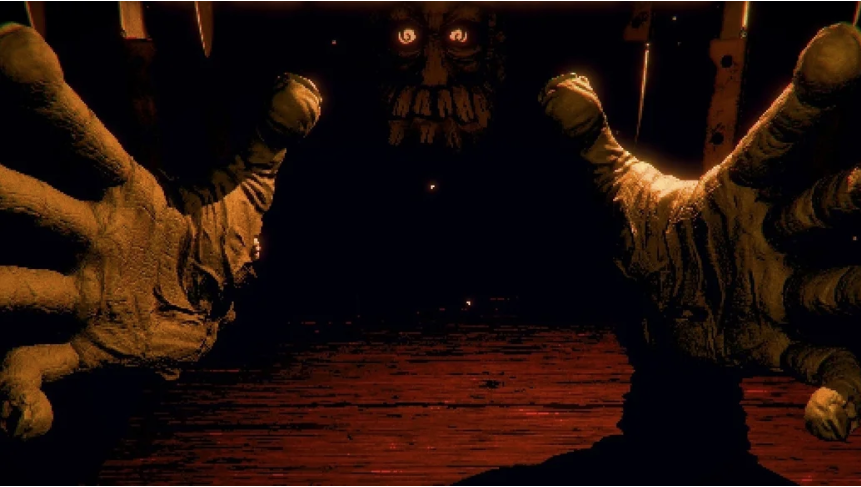
The most obvious purpose, in my view, is that it enhances the game’s sense of dread. Inscryption is an ominous game. The first part, in particular, might be the best example of a ‘Southern Gothic’ atmosphere in gaming [1]. The rickety lodge, dark in every corner and filled with strange oddities, seems to be merging with the nature around it. The lodge’s sinister owner captures creatures in photographs and forces you into a game based around animal sacrifice; when you fail, you join the fate of these animals.

So far, so creepy. But when the game zooms out and you discover it is part of a ‘real-world’ conspiracy tied to a mysterious prototype not meant to be seen by the public, it becomes uncanny. If you were ever freaked out as a kid by that one episode of The Simpsons where Homer gets lost in the human world, you know the feeling I mean. When media crosses forms effectually, it feels weird – it feels wrong. So when Inscryption crosses into the real world, with live-action video, it is as if the game has real-world consequences – and this creates a feeling of genuine unease I have rarely felt playing video games.

The second, more implicit effect of Inscryption’s metanarrative is that it forces a feeling of complicity in the player. As the game’s story becomes increasingly focused around the ‘Great Transformation’, it becomes clear that the varying motivations of the game’s characters require your agency to fulfil them. They might be sentient, but they remain bits of code – they need an input to give an output. P03 needs your files and thus creates a game to trick you into giving them to him; Leshy et al. need your input, your mouse-click, to ultimately overthrow him. You have little choice to change these actions – other than to stop playing entirely. But just like Luke Carder before he unpacks the OLD_DATA despite being warned not to, you’re not going to stop, are you? Yes, Inscryption flips the script. It asks what is being played, here: the game, or you?

Ultimately, then, Inscryption works because when it gets meta, post-modern, whatever, it serves the story. It never feels forced, out-of-place, or kitsch. This is a pretty remarkable achievement considering just how far the game goes in blurring the gap between reality and the game: the use of your system’s own files (and even threatening to ‘permanently’ delete them) is just the most obvious example here. It also helps that the game(s) underlying it are pretty good, too. Yeah, they might not be the deepest and most balanced roguelikes or card collectors out there, but the gameplay in each act is sharp – simple to learn with an appropriate difficulty curve that makes winning feel satisfying but rarely laborious. Furthermore, the speed at which each Act moves on and changes game-styles provides a frenetic vibe that ensures you’ve moved on long before you can start picking holes and ‘optimizing the fun’ out of each part. Combining this gameplay with a genuinely creepy and engaging narrative makes Inscryption one of the best indie horror games we have.

[1] Perhaps tied with Resident Evil 7: Biohazard, to be fair.

New Star GP: Master of None

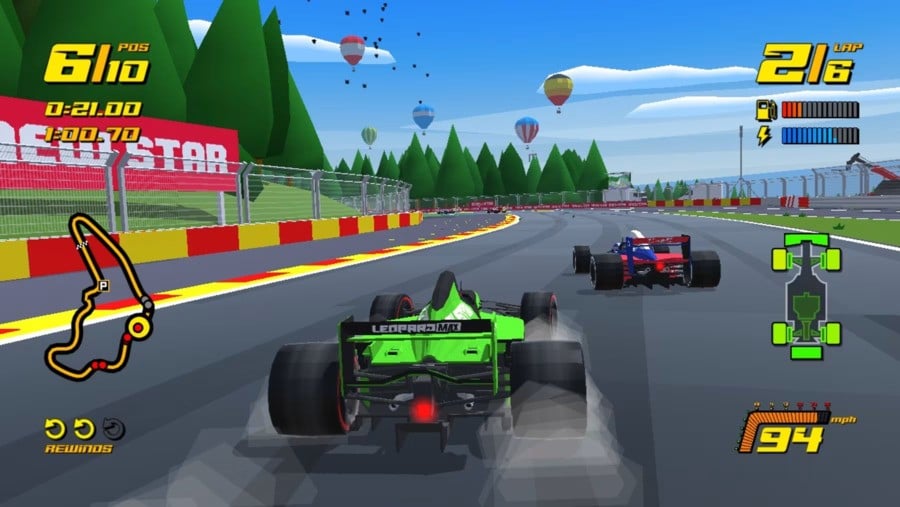
New Star GP is like the tapas of racing games. The game serves a little of classical arcade racing in its driving mechanics and visuals, some simulation in tyre choice and pit strategy, a portion of Need for Speed-style upgrades, and even – dare I say it – a touch of Mario Kart in the rocket boost mechanics.

All this gives the game a “jack of all trades, master of none” feel. Some parts work better than others, however. I enjoyed the combination of the arcade-y driving and visuals with the simulation-style strategy of managing your tires and fuel. This created some real nail-biting moments when I tried to push for just-one-more-lap whilst my fuel reached its last bar, or as the rain started to fall more heavily.

I also liked the multiple game-modes embedded into the long career, keeping the game fairly fresh even when the driving mechanics became quite stale. A particular highlight was pissing off a competitor in a race so severely they angrily challenge you to a one-on-one rivals race later on. Moments like this give the game a real sense of charm.

Other parts did not work, however. The need to manage your team in between races – presumably inspired by games like F1 Manager – felt redundant at best and frustrating at worst. Keeping my commercial manager happy, for example, clearly had little bearing on the game itself, especially when you’re given the option to literally buy their happiness at a cheap price. Hiring and firing staff members also felt pointless and more hassle than it was worth.

Other elements didn’t just feel redundant, but negatively affected the gameplay experience. Upgrading your car, for example, felt significantly unbalanced. The gimmick is that over the course of each 10-grand prix season, you and your opponents must upgrade your car to stay competitive. However, it’s pretty clear that your opponent is not actually upgrading, but rather that the AI difficulty is just adapting to your skill level. This creates an artificial feeling of difficulty that tries to make your upgrades feeling meaningful, but instead creates an oscillating effect where if one race is too easy, the next will be difficult, and vice versa. The difficulty problems are only worsened when you realize that it is only you that gets the nitro-boost mechanic each lap, giving you a clear unfair advantage over your AI opponents.

Ultimately, New Star GP tries to do too much, sacrificing technical depth for superfluous and sometimes overbearing mechanics. Just like tapas, the game is satisfying enough, but you come away still a little hungry for more.

Lonely Mountains: Snow Riders is One of the Best Snowboarding/Skiing Games Ever

There was a time when nearly anyone with a home console owned a snowboarding game. In the late 1990s and early 2000s, critical and commercial successes like 1080 Snowboarding (1998), SSX Tricky (2001), and SSX (2003) dominated the market and spawned a dozen not-so-acclaimed knock-offs. Then, somewhere in the mid-2000s, these winter sports games fell out of favour; they disappeared.

So what happened? One likely reason is that these games were extraordinarily same-y. Games that attempted to replicate the success of SSX usually felt derivative. They copied not just the series’ arcadey gameplay but its aesthetic and humour, too: and, by the late 2000s, the bombastic, hyperactive, maximalist vibe was just not doing it anymore. Even more recent attempts to renew the genre, such as Rider’s Republic (2021), hold an echo of this feeling. As a result, even in 2025 there is a remarkable – and disappointing – dearth of games in this genre.   

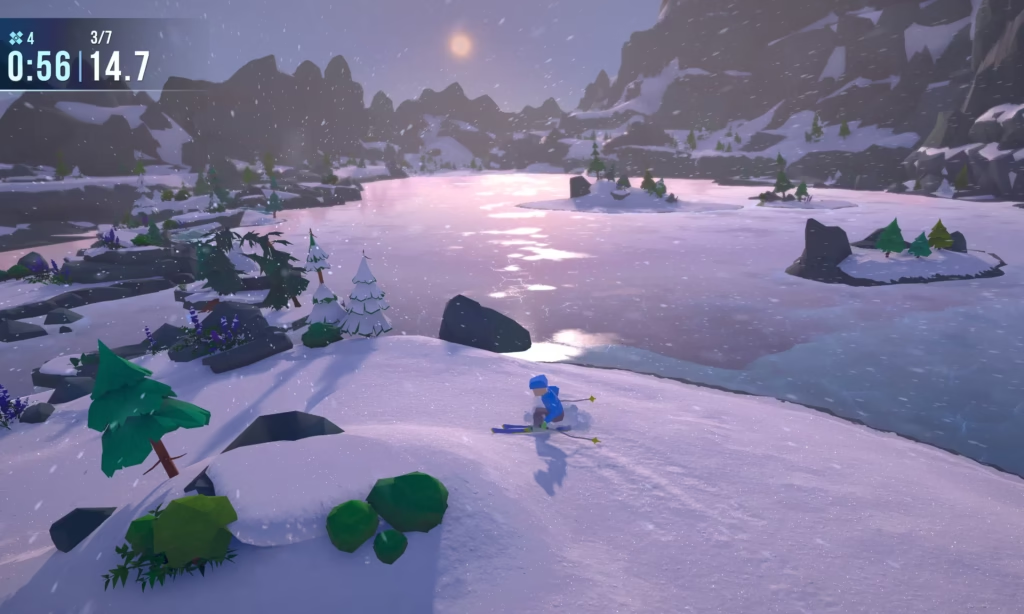
               What the genre needs, then, is exploration and experimentation – and this is where Lonely Mountains: Snow Riders (2025) stands out. Quite the opposite of SSX’s gaudy silliness, Lonely Mountains is a slow, no-frills game – it’s your character and your skis, and you have to get to the bottom of a big snowy hill without falling off. That’s it. No power-ups, no boost, no insane tricks with crazy multiplier bonuses.

               Make no mistake, though, this is not an easy game. This is tricky, risk-reward gameplay, where a slight misinput is the difference between gliding carelessly past a tree at 60kmh or faceplanting directly into it. Mastery over player movement is everything. And gratefully, the movement is excellently weighted and extremely responsive. You can feel the changes in friction as you glide over differing depths of snow; you must balance speed and control on a second-to-second basis. This can be punishing, but still remains forgiving enough to produce some exhilarating holy-shit-I-cant-believe-I-got-away-with-that moments. Rarely do you crash and think it wasn’t your fault – the promise of control is always there, even if you can’t quite grasp it yet.

               The game’s presentation is also excellent. Trails are calm and quiet. There’s no music, just the ambient sounds of the mountain and your skis swishing through the snow. The art direction is beautiful, too – the mountains glitter in the sun, and snow whips gently in the wind. It’s like you’re playing a game inside a long-forgotten snowglobe.

               These clean aesthetics extend to the game’s philosophy, too. This is a no-bullshit game, with simple, intuitive game-modes, and no commercialized battle-passes, microtransactions, et cetera – even though it would’ve been easy enough to shoehorn these into the game’s multiplayer. The result of this is a friendly and charming multiplayer experience, where players of all skill levels are cheered for simply crossing the finish line, and where competition arises organically – not from level markers or skill-based matchmaking. Stumbling upon someone roughly of your skill level often leads to tense one-on-one races where you push each other to your limits in friendly rivalry – it reminds me of the multiplayer days of yore, before rampant commercialization.

               There is one sticking point that may put off some people, however: the camera. Instead of opting for a simple over-the-shoulder perspective, the game uses a static camera that shifts to different predetermined positions as you move through the track. This is intended, I imagine, as an additional challenge in the game: when the camera is behind you, the goal is speed; but when it’s in front of you and you can’t see what’s coming next, it’s a game of momentum and anticipation.

               This adds to the game’s novelty, for sure, but the effect isn’t always great: the constant shifting occasionally feels like you’re watching your character from the perspective of an indecisive drone, and at high speeds, it almost gave me motion sickness. After a few dozen hours with the game, I ‘get’ the camera and what it’s aiming to do – but I still can’t help but wonder if the game would be more satisfying if it just remained still. This is one of those things that is purely personal taste – some will be turned off the game on account of it, and some will love it for its unique challenge.

               Nevertheless, Lonely Mountains succeeds not just because it is an excellently realized, beautifully-made game: it succeeds because it innovates and advances a fading genre. By inverting the lurid, high-octane style of most winter sports games and injecting it with a contemporary focus on mechanical challenge, the game poses the question: what more could this genre be with some daring experimentation? For this reason, Lonely Mountains deserves a place as one of the best and most exciting games in its category.

Alan Wake II: Great TV

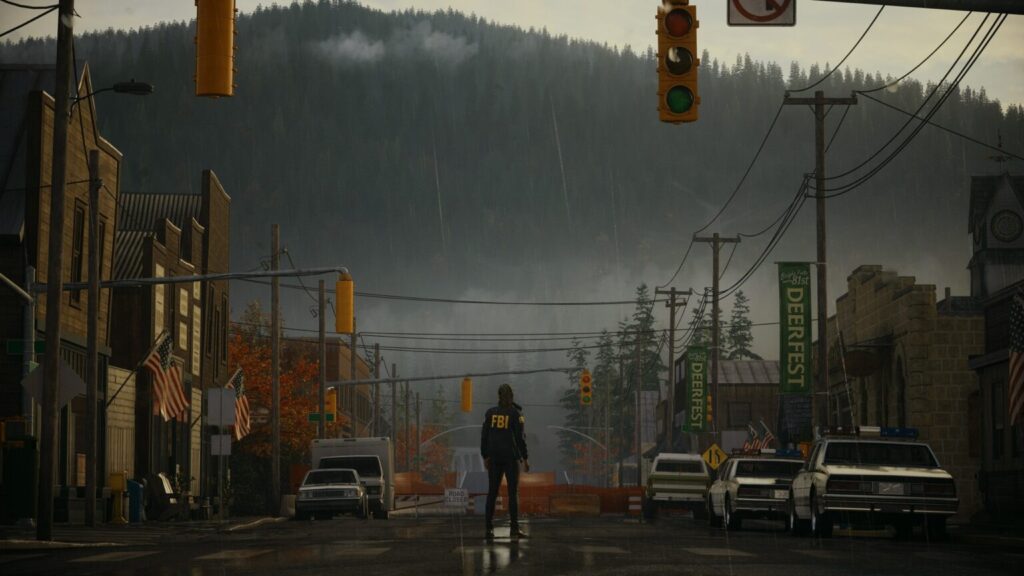
There’s an as-yet-unnamed subgenre of video games that’s analogous to arthouse cinema. Philosophical in theme, non-linear in its storytelling, and visually experimental, Alan Wake 2 is now surely one of the exemplars of this category, taking its place among the other usual suspects – Silent Hill 2, The Stanley Parable, Deus Ex, etc.

Being the cultured and refined gamer that I am (read: pretentious and insufferable), I knew I had to play it. Ultimately, I was impressed. This is a game that respects the player’s intelligence. There is a sharp directorial vision that makes no concessions to didactically spelling out its central message. Everything in the game, from the brilliantly executed visual design to the not-so-brilliantly executed ambiguous ending, is constructed to maintain an pervasive sense of disorientation and unease. If you’ve watched a David Lynch film, you know this feeling. This isn’t accidental: auteurist director Sam Lake has professed Lynch as the main inspiration for his work.

And for me, that’s kind of the problem with Alan Wake 2: it draws so much from the language of film that one begins to wonder why it bothers being a video game in the first place. The most obvious example, of course, are the live-action cinematics. Frequent, highly stylized and well-acted, these break up the gameplay and also interrupt it through the use of cutaway jump scares. The cinematography here is bold and excellent – as the player-character, you’ll find yourself walking through scenes that wouldn’t be out of place in a high-budget HBO show. The influence of film, too, is evident in the game’s motifs: you’re on a talk-show, televisions are often interactable objects, there’s a level in a cinema, two of the characters are filmmakers, et cetera.

There’s nothing inherently wrong with making cinematic games, of course. Some of the most acclaimed games of the last fifteen years, such as Red Dead Redemption 2 and The Last of Us, resonate because they use a filmic style that feels immediately recognizable and comfortable for the player.

In Alan Wake 2, though, the devotion to cinema clashes directly with the gameplay. This is not just because the combat and movement are clunky or frustrating (though that certainly doesn’t help). It’s also that the gameplay elements designed to forward the story are so banal they feel anti-immersive. For example, the plot-switching mechanic in Wake’s sections has the potential to use the unique interactivity of gaming to advance and deepen the story. But in practice, it amounts to little more than clicking through each option until you find the right one.

Similarly, Saga’s case board could have acted as an excellent mechanism through which to get at her thought process on a deeper level, as John’s diary is in RDR2 – but ends up being a simple event log, no more than a pace-killing chore when you’re occasionally forced to update it. Further, the ability to switch between the two characters’ storylines is a nice touch that utilizes the non-linear potential of video games, but in practice doesn’t do a great deal to deepen the story in any meaningful sense.

Eventually it started to feel like Alan Wake 2’s gameplay got in the way of the story. I was simply walking between cinematic cutscenes, killing a few irritating bad guys and solving some cookie-cutter puzzles along the way. It is ironic, I feel, that a game that primarily explores the interrelations between mediums, and between medium and reality, is completely lacklustre in its attempts to merge its gameplay with its cinematic elements.

Ultimately, Alan Wake II proves that video games can rival the visual and narrative quality of prestige TV – but by overlooking the uniquely storytelling potential of interactivity, you start to question whether it needed to be a video game at all.

Chrono Trigger: A Masterclass in Story Pacing

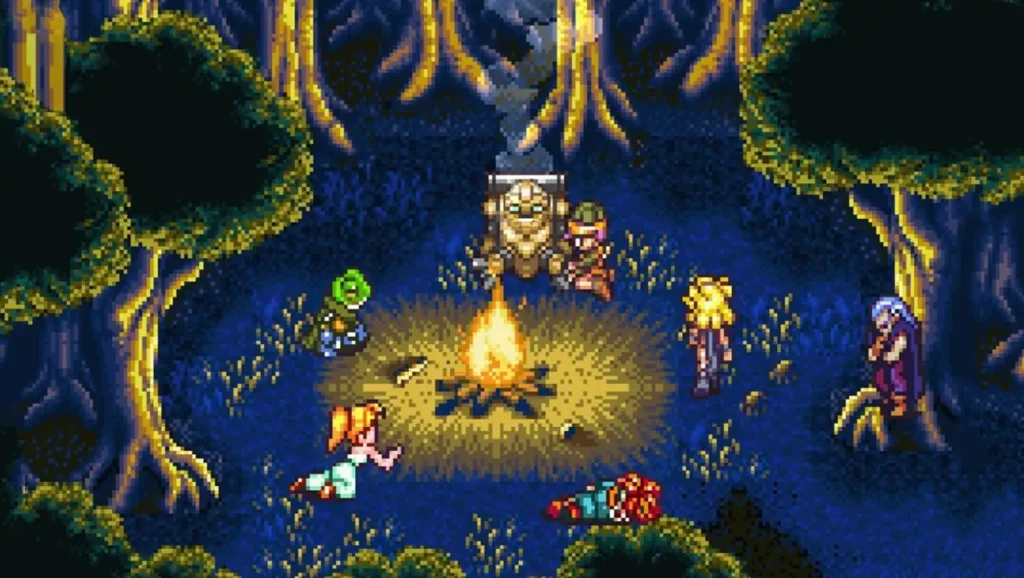
Anyone who’s spent any time trawling “Best Games of All Time” lists will know the storied place 1995’s Chrono Trigger holds in the pantheon of gaming. So renowned is its legacy that to bring it up is almost a cliché, a signal of a supposed deeper-than-average gaming knowledge. Recently, I finally decided to play Chrono Trigger for myself, and I have to admit – they’re all right. This is a game that, now 30 years after its release, still feels remarkably engaging and exciting. Somehow, it still feels new – it endures.

            This made me question: What makes a game endure? What element of a game’s design makes it timeless, even away from the rose-tint of nostalgia? Is it graphics? Gameplay? The music? These elements certainly help, and Chrono Trigger excels in them, but a beautiful-looking game from the 1990s can age poorly, and a game that’s fun to play can easily be forgotten over the years.

            No – what makes Chrono Trigger endure is its story. And more specifically, its story pacing. For my money, no other game, modern or classic, quite devotes itself to the art of pacing as Chrono Trigger. Let me explain.

            Every facet of the Chrono Trigger’s design seems geared towards maintaining forward momentum. The most obvious example of this is the way the story beats upfold. Within twenty minutes of booting up the game, the stakes are established – the tomboyish girl you’re hanging out with falls into a time portal, and you gotta go save her. Simple enough save-the-princess fare. Misunderstanding of your role in her rescue then places you in prison – OK, a nice twist in the standard tale. You escape via a time portal that puts you in a destroyed world far in the future, and you realize you can use this time technology to save the world – Now it’s getting interesting.

This all occurs within the first few hours of the game, and, remarkably, the layers of intrigue continue to unravel at a consistent speed throughout the game’s 20-hour span. One moment you’re riding a jetbike in a cyberpunk-esque future, the next you’re fighting dinosaurs 65 million years in the past. Chrono Trigger never lets you sit in one place for so long you get bored, nor moves so quickly you lose track of your goal. In this sense, the story is expertly balanced – a true masterclass in pacing.

            Crucially, though, it’s not just the story that contributes to pacing – the gameplay does, too. There is practically no bloat whatsoever here. You have all the tropes you’d expect of classic JRPGs – turn-based party battles, experience points, ‘mana’, and so on. However, these gameplay elements are all manipulated in the grander effort to respect your time. There are no random encounters. Experience is shared amongst your whole party, so switching party members is easy and doesn’t require you to grind whatsoever. There’s different weapons and items with varying effects, but these are simple enough that you rarely have to labour over what armour to equip, which weapon would suit your party best, and the like.

            The battles themselves, too, are guided by this notion of pacing. They occur in real-time, despite being turn-based, which makes for a dynamic and engaging experience that mostly holds up today. They are typically over in a matter of seconds, perhaps minutes for boss-battles, and you’ll rarely – if ever – find yourself having to grind levels to beat them. Nevertheless, they still feel challenging enough to put your mind to work – in the tougher battles, for instance, you have to think carefully about how to synergize your party members in order to deal damage whilst keeping everyone alive.

            The importance of all this is that the momentum of Chrono Trigger never dies. Every hour you spend playing the game feels like significant progress towards the ultimate goal of defeating Lavos, the Big Bad [1]. And by gearing every element of the game towards pacing, the result is that you care about the story and the characters a great deal more than you would if you’d sat around dealing with meaningless fetch quests and drawn-out battles. The characters in Chrono Trigger are racing against the clock to beat the odds and save the world. Matching the game’s pacing to this sense of urgency creates a sense of captivating immersion that remains extremely rare in the medium of gaming – and that is what makes this game endure.

[1] The only part that felt like a drag was the Lost Sanctum part of the game – which I later discovered was a much-maligned addition for the Nintendo DS port.